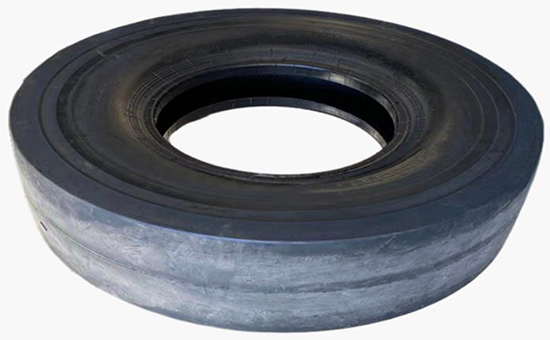
Roller smooth tires mainly run on newly paved asphalt surfaces, where the tread must continuously come into contact with oily substances in the asphalt during operation, requiring the compound to have excellent wear resistance, oil resistance, and aging resistance. Traditional smooth tire tread rubber is generally made from general-purpose rubbers such as natural rubber, styrene-butadiene rubber, and cis-butadiene rubber; With the continuous development of the reclaimed rubber industry, many smooth tire tread rubbers have begun to incorporate nitrile reclaimed rubber. Why is that? What should be noted when mixing nitrile reclaimed rubber into the tread rubber of smooth road rollers tires?
1. The advantages of mixing nitrile reclaimed rubber into the tread rubber of smooth tire rollers
(1) Nitrile reclaimed rubber improves the oil resistance of smooth tire tread on road rollers, avoiding swelling and material sticking issues
General rubbers such as natural rubber, styrene-butadiene rubber, and cis-butadiene rubber have poor oil-resistant media performance; During smooth tire operation, the tread rubber must be in prolonged contact with high-temperature asphalt and other oily E5LYY1223 substances, which can easily swell and cause stone adhesion, seriously affecting tire lifespan and operational efficiency. Nitrile reclaimed rubber is made from waste nitrile rubber and its products, offering excellent oil resistance. Adding an appropriate amount of nitrile reclaimed rubber to smooth tire tread rubber improves oil resistance and prevents abnormal wear caused by rapid swelling.
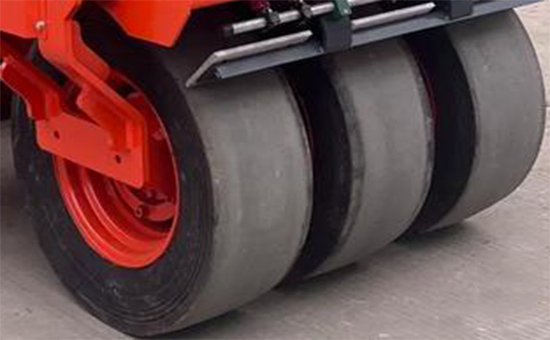
(2) Mixing nitrile reclaimed rubber into the tread rubber of road rollers can effectively reduce raw material costs
Nitrile reclaimed rubber is regenerated from desulfurized waste nitrile rubber or waste nitrile rubber products, retaining the basic performance characteristics of nitrile rubber, with a high oil resistance coefficient, good heat and wear resistance, and is much cheaper than natural rubber, styrene-butadiene rubber, and cis-butadiene rubber. Adding an appropriate amount of nitrile reclaimed rubber to the tread rubber of smooth tires can effectively reduce raw material costs. Compared to virgin rubber, reclaimed rubber has better plasticity and flowability, which can improve the processing performance of smooth tire tread rubber and reduce production energy consumption.
2. Tips for mixing smooth tire tread rubber with nitrile reclaimed rubber for road rollers
(1) Control the amount of nitrile reclaimed rubber
When producing roller smooth tire tread rubber using natural rubber and styrene-butadiene rubber as main raw materials, the proportion of nitrile reclaimed rubber is controlled at 20%-30%. This not only improves the tread rubber's oil resistance but also keeps the tire appearance smooth, shiny, and elastic.
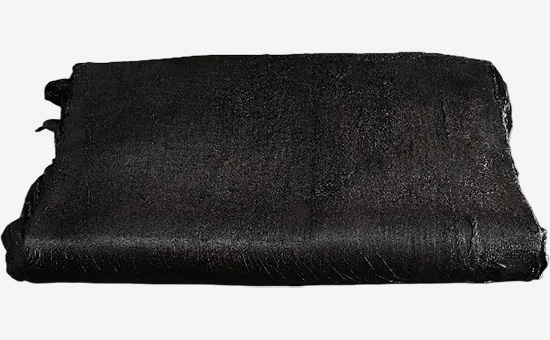
(2) Reasonably design the tread rubber formula for smooth tires
When the tread rubber for smooth roller tires is mixed with nitrile reclaimed rubber, the vulcanization system can mainly be a sulfur-accelerator system. For heat resistance and low compression deformation, low-sulfur, high-accelerator is used, or sulfur-free/low-sulfur systems such as Qualum (such as TT/TS) + thiazole (such as DM) are used. The reinforcement filling system combines high-wear-resistant carbon black and semi-reinforced carbon black, balancing the mechanical strength, oil resistance, and compression deformation of the compound compound; If necessary, use white carbon black and active magnesium oxide to further improve the strength and heat resistance of the tread rubber.
(3) Pay attention to the tread rubber mixing and adding sequence
When producing smooth tire tread rubber for rollers in appropriate proportions of natural rubber, styrene-butadiene rubber, and nitrile reclaimed rubber, a two-stage mixing process can be used in the small combination test: the first stage is mixed in the internal mixer, rotor speed set to 40 r/min, and the feeding sequence is raw rubber, nitrile reclaimed rubber, zinc oxide, stearic acid, etc. After pressing for 40 seconds, half of the carbon black and aromatic oil are added, followed by another 30 seconds of pressing and 30 seconds of lifting before discharging; The second stage of mixing is transferred to the open mill, where the first stage of the mixing rubber is processed with sulfur and accelerators for final refinement.
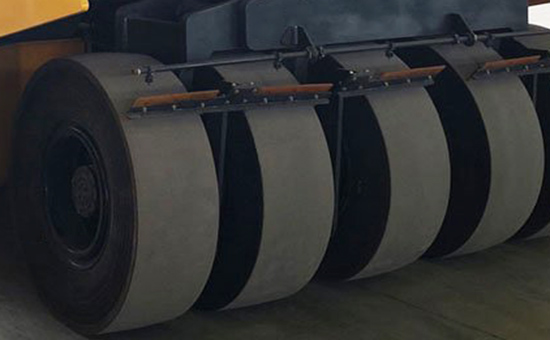
When adding nitrile reclaimed rubber to the tread rubber for smooth tire rollers, the large-scale coordination test recommends a three-stage mixing. The first stage mixing is done at 40 r/min speed, where raw rubber, nitrile reclaimed rubber, zinc oxide, stearic acid, etc. are added in the mixer, and half the carbon black and aromatic oil are added in stages; For the second stage mixing, at 40 r/min, add half of the remaining carbon black in the internal mixer; The three-stage mixing is performed at a speed of 20 r/min, with sulfur and accelerators added. Multiple pressing and lifting operations ensure uniform dispersion.
When mixing nitrile reclaimed rubber into the tread rubber of smooth road roller tires, special attention must be paid to the compatibility among the reclaimed rubber and raw rubber. Control the dosage ratio of the reclaimed nitrile rubber and adjust the rubber formula appropriately. Later, we will share with you the vulcanization formula for roller smooth tire tread rubber using natural rubber/styrene-butadiene rubber/nitrile reclaimed rubber or natural rubber/nitrile rubber/neoprene rubber/nitrile reclaimed rubber combined to produce roller smooth tire tread rubber vulcanization.
Exclusive original article [commercial authorization] reprint, excerpt and excerpt in any form are prohibited without written authorization. Focus on Hongyun rubber: learn the process formula and raw material technology of producing rubber products from recycled rubber to help you reduce costs and increase profits