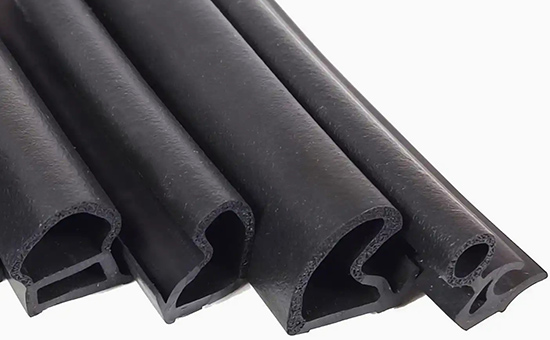
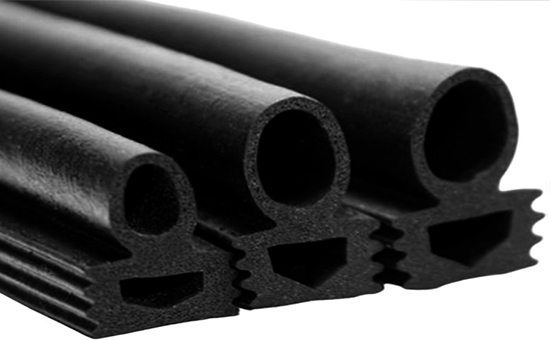
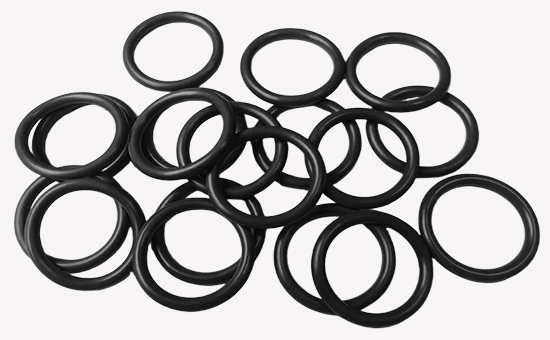
When using EPDM reclaimed rubber to replace virgin EPDM for the production of automotive door and window seals, door frame seals, appliance sealing rings, or sponge foam rubber products, the rubber products need to maintain good softness, elasticity, and sealing performance while also being able to withstand certain mechanical strength and repeated deformation. The rubber compound is required to have low hardness and high tensile strength. So, how can a low-hardness, high-tensile EPDM reclaimed rubber formulation be designed?
1. Reasonably use oil-extended EPDM rubber in low-hardness, high-tensile EPDM reclaimed rubber formulations
When preparing low-hardness, high-tensile rubber compounds using EPDM reclaimed rubber, oil-extended EPDM rubber can be used appropriately. EPDM rubber has low density and high filler absorption characteristics, allowing it to take in large amounts of mineral oil and non-reinforcing fillers, which can improve compound performance and reduce material costs. The 'dilution effect' from large amounts of oil and fillers can significantly reduce compound hardness while maintaining sufficient tensile strength.
2. It is recommended to use a conventional sulfur vulcanization system in low-hardness, high-tensile EPDM reclaimed rubber formulations
Sulfur is the most commonly used vulcanizing agent for EPDM reclaimed rubber products. When designing low-hardness, high-elasticity EPDM reclaimed rubber formulations, it is recommended to use a conventional sulfur vulcanization system to form polysulfide crosslinks, which have relatively long bond lengths, strong mobility, and stress dispersion properties, suitable for high elongation requirements and cost-effective. If necessary, a semi-effective vulcanization system combining sulfur and accelerators can be used to form monosulfide and disulfide bonds, providing both high elongation and low hardness, especially for rubber products requiring high heat resistance and low compression set.
3. It is recommended to use EPDM reclaimed rubber with high rubber content in low-hardness, high-tensile formulations
When preparing low-hardness, high-elasticity rubber products using EPDM reclaimed rubber, the higher the rubber content in the reclaimed rubber, the better the elasticity and the greater the tensile strength.
4. It is recommended to use highly reinforcing carbon black in low-hardness, high-tensile EPDM reclaimed rubber formulations
High-abrasion carbon black has smaller particle size and higher specific surface area, significantly improving the tensile strength, hardness, and abrasion resistance of EPDM reclaimed rubber. Semi-reinforcing carbon black has a larger particle size and lower surface area, providing weaker reinforcement for EPDM reclaimed rubber but improving processing performance, reducing hardness, and increasing elongation at break. Furnace black for extrusion has even larger particle size and lower surface area, which can increase compound hardness and set stress while reducing costs. Different types of carbon black provide varying reinforcement effects in EPDM reclaimed rubber.
When preparing low-hardness, high-tensile EPDM reclaimed rubber products, it is recommended to use highly reinforcing carbon black and reasonably adjust the type and amount to produce rubber products that meet demand.
EPDM reclaimed rubber is generally processed from EPDM production scrap, unvulcanized EPDM, or waste EPDM rubber seals. It has excellent high and low temperature resistance and can be used alone or blended with EPDM rubber, butyl rubber, or reclaimed butyl rubber to produce heat-resistant, ozone-resistant, weather-resistant, and aging-resistant products, effectively reducing raw material costs and production energy consumption while ensuring the product's performance.
Exclusive original article [commercial authorization] reprint, excerpt and excerpt in any form are prohibited without written authorization. Focus on Hongyun rubber: learn the process formula and raw material technology of producing rubber products from recycled rubber to help you reduce costs and increase profits